Travel & Planning for New Destination Released. Free Shipping to Most Countries Around the World.
Free Shipping to Most Countries Around the World.
Coming in through the south gate, the first thing you’ll see is the Circular Mound Altar. At its center sits the Heart of Heaven Stone, and you really shouldn’t skip it. Stand in the middle and make a wish to the heavens. The center stone counts as one, and the ring of fan-shaped slabs around it grows outward in multiples of nine: 9, then 18, then 27, all the way up to the ninth ring at 9×9=81 slabs. Why the obsession with nine? To the ancients, nine was the number of heaven, the highest of the yang numbers, meaning the emperor’s wishes could reach straight through the nine layers of the sky. It represented the highest ritual gesture a mortal could offer to heaven.
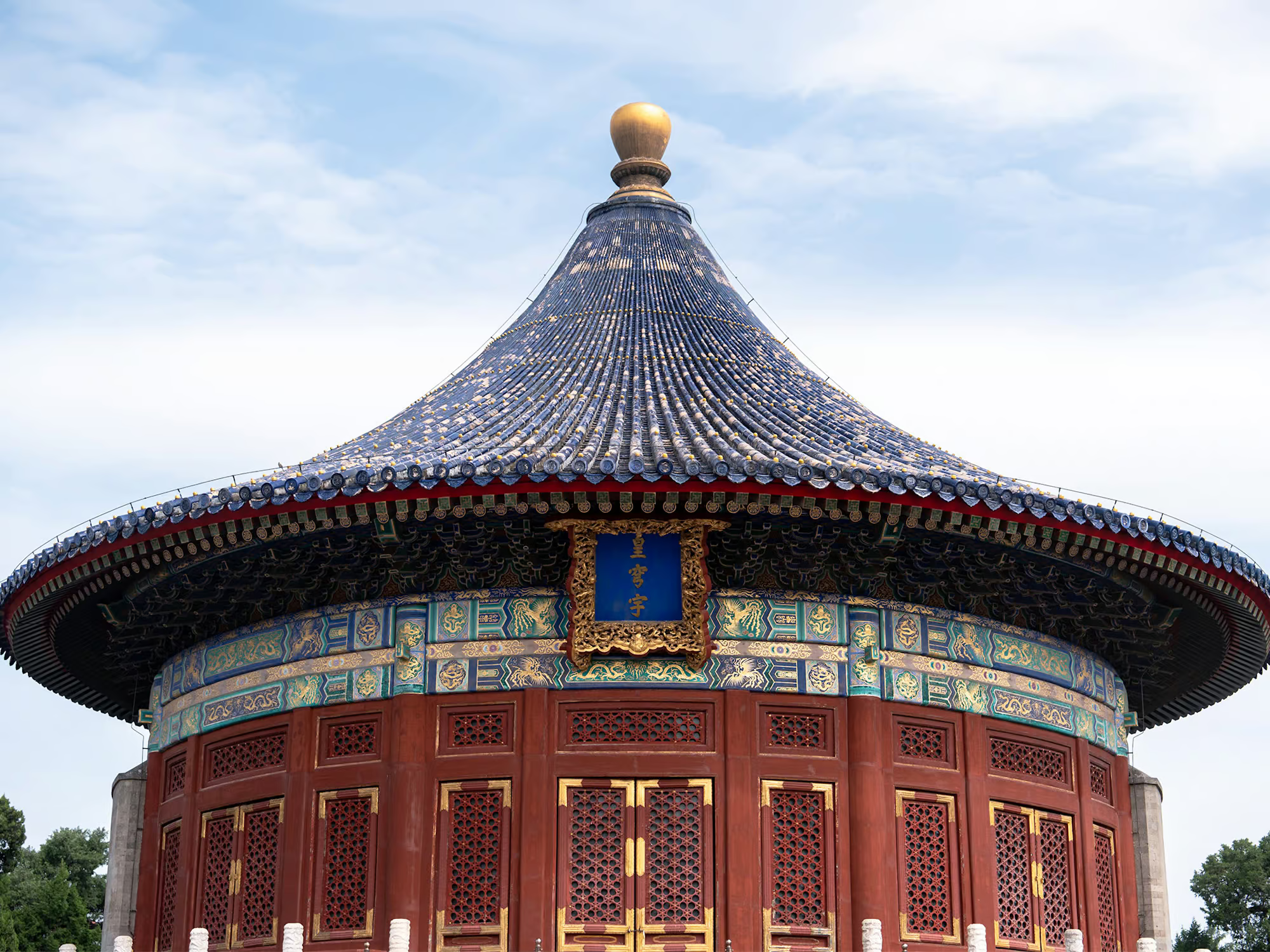
The first photo shows the Imperial Vault of Heaven. When it was first built, it had a double-eaved roof, which was changed to the current single-eaved design during the Qianlong era. Outside the east and west side halls runs the Echo Wall, wrapping the entire courtyard in a single continuous ring. I actually remember experiencing this acoustic effect as a kid. Now that I’m older, getting myself, an introvert, to shout across the courtyard so someone on the other side can actually hear me, especially with a crowd around, no thanks, too embarrassing. Supposedly the wall’s bricks fit together so precisely you couldn’t wedge even a coin into the seams, and combined with its exact curvature, sound waves lose almost no energy as they travel, bouncing back and forth to create the echo. The stone paving around the Imperial Vault’s center stone works differently from the Circular Mound Altar. Instead of nine, it expands in multiples of eight, one for each of the eight directions: north, south, east, west, and the four in between. The inside of the Imperial Vault isn’t open to visitors right now, but it holds a beautiful caisson ceiling in shades of blue and green.
Near the Danbi Bridge, close to the Hall of Prayer for Good Harvests, stands a green-glazed cylindrical structure that looks a bit like an ancient bronze cauldron. It’s called the Burning Wood Furnace, used for offerings to heaven. What got burned typically included a cleaned calf, silk goods, and wooden tablets inscribed with prayers. Another interesting sight is the Seven Star Stones, set on the lawn southeast of the Long Corridor. Legend says they were placed during the Jiajing era of the Ming Dynasty to mirror the positions of the Big Dipper, representing the peaks of Mount Tai and meant to anchor the site’s feng shui. But count carefully and you’ll actually find eight stones. The extra one was added later, during the Qianlong era, to emphasize that the Manchu and Han were one family, all descendants of the same ancestors. Classic move from the emperor who loved calling himself “perfect in ten things” and never missed a chance to make a point.
We use cookies to optimize your experience, analyze usage, and personalize content. Your continued browsing indicates consent to our cookie usage and the sharing of site interaction data with our marketing and analytics partners.