Travel & Planning for New Destination Released. Free Shipping to Most Countries Around the World.
Free Shipping to Most Countries Around the World.
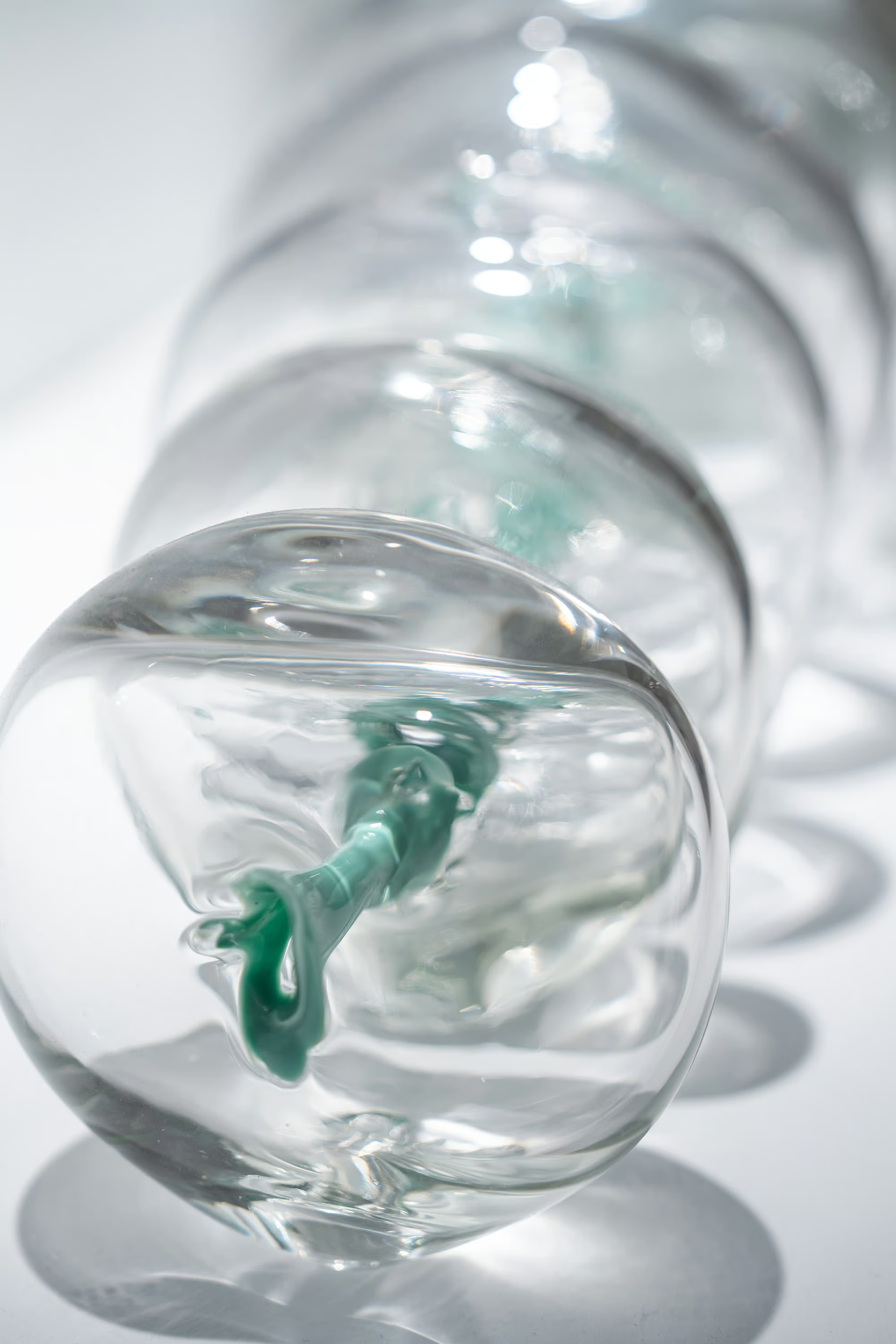
The glass orb piece is quite abstract. It’s a work by Wang Xinyu from the Arts and Crafts department, titled Here and There. Using chaotic, mutually adhering spherical spaces, it constructs a sense of enclosure and separation, serving as a metaphor for each individual’s exploration of their own origins and connections to the outside world, across both visible and invisible spaces. External light passes through a teal sphere concealed within the inner space and extends outward, as if the self is moving back and forth between the spiritual and the real in restless pursuit.
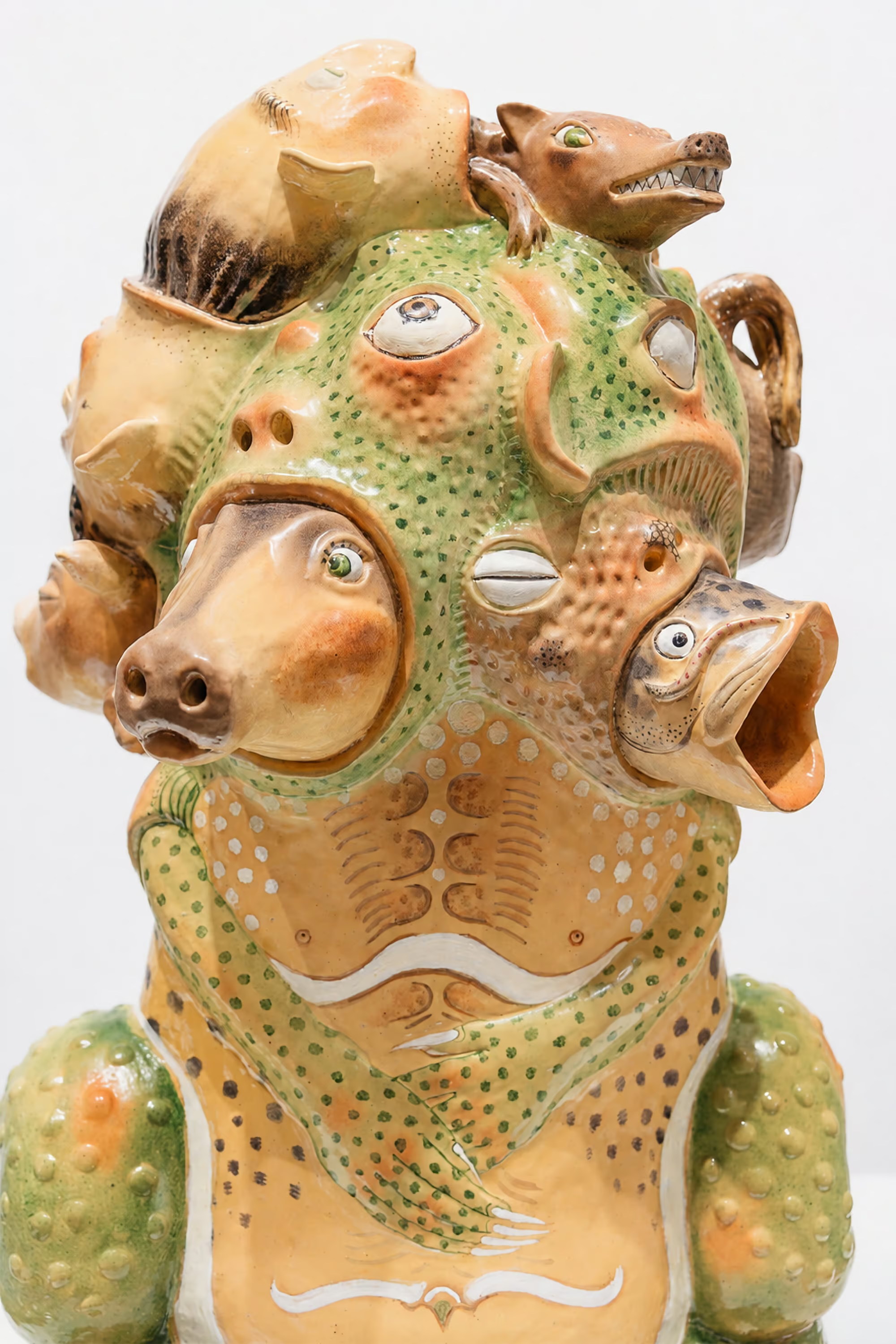
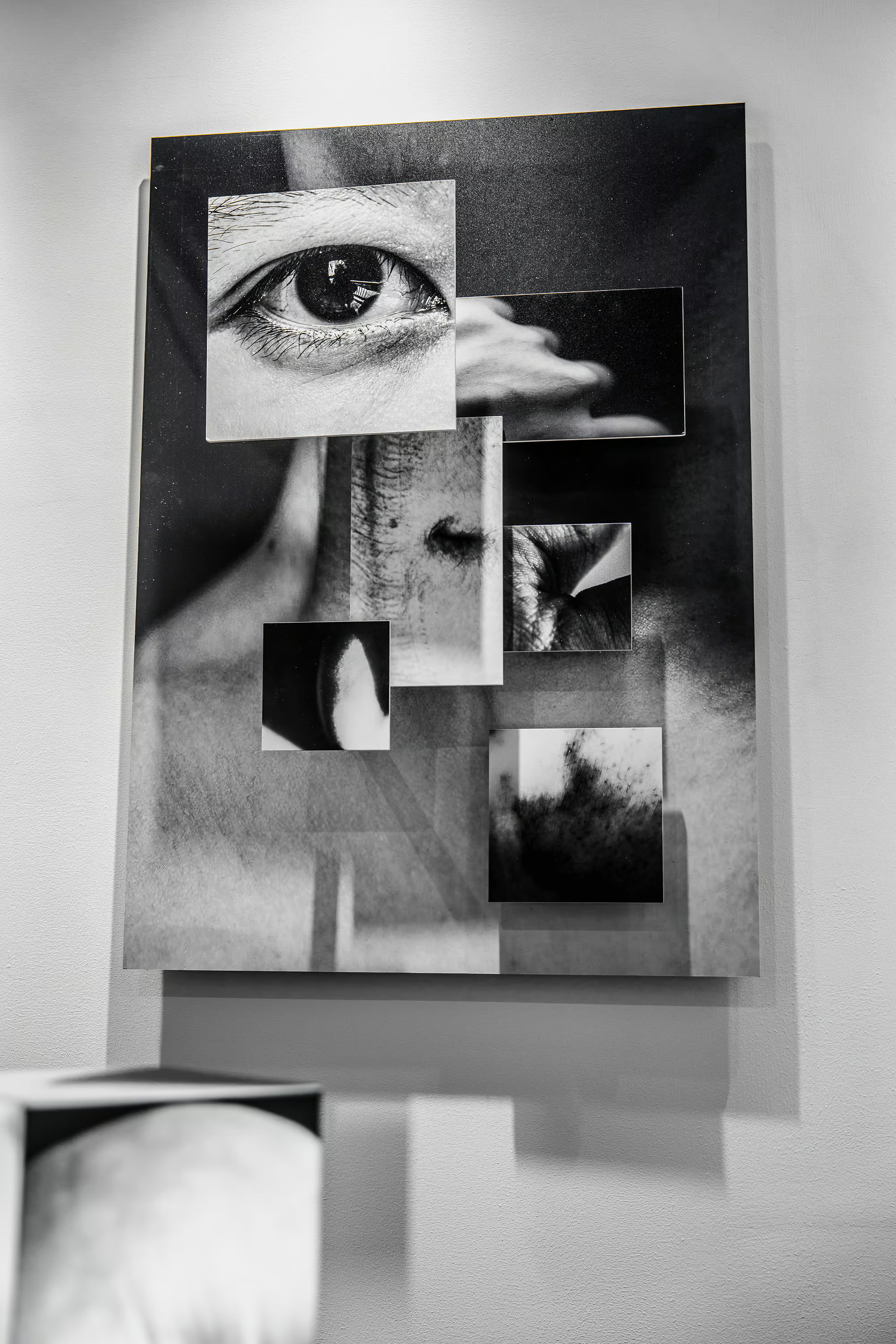
The next piece looks very much like an illustration, but is actually one of the most quietly compelling Chinese installation art works in the show. I love its playful yet contemporary sensibility. It’s by Wang Shuyi from the Ceramic Arts department. You can see many different animals threading through human-shaped torsos and limbs, with mouth, abdomen, and throat connected across the body, creating a fantastical structure in which everything breathes into and out of everything else. The work dismantles the conventional assumption that humans are the central subject, and reopens the question of animals as beings equal to humans, challenging the hierarchies and dependencies that exist between species. Cats and dogs were never meant to be our pets; chickens and ducks were never meant to be merely our food. The forms sever, from the outset, the boundaries and relationships of subordination between humans and other species. Working in a similar spirit is the black-and-white piece titled Fragments, which likewise breaks apart conventional thinking before reassembling it. The artist observes that images circulating on today’s social media have already become fragmented by the time they reach their audience. Viewers tend to fixate only on isolated parts of an influencer’s or individual’s body, and on details within details. Artist Cai Yu’er uses partial cropping and spatial reconstruction to present the public with visual fragments that are at once separated from and related to one another.
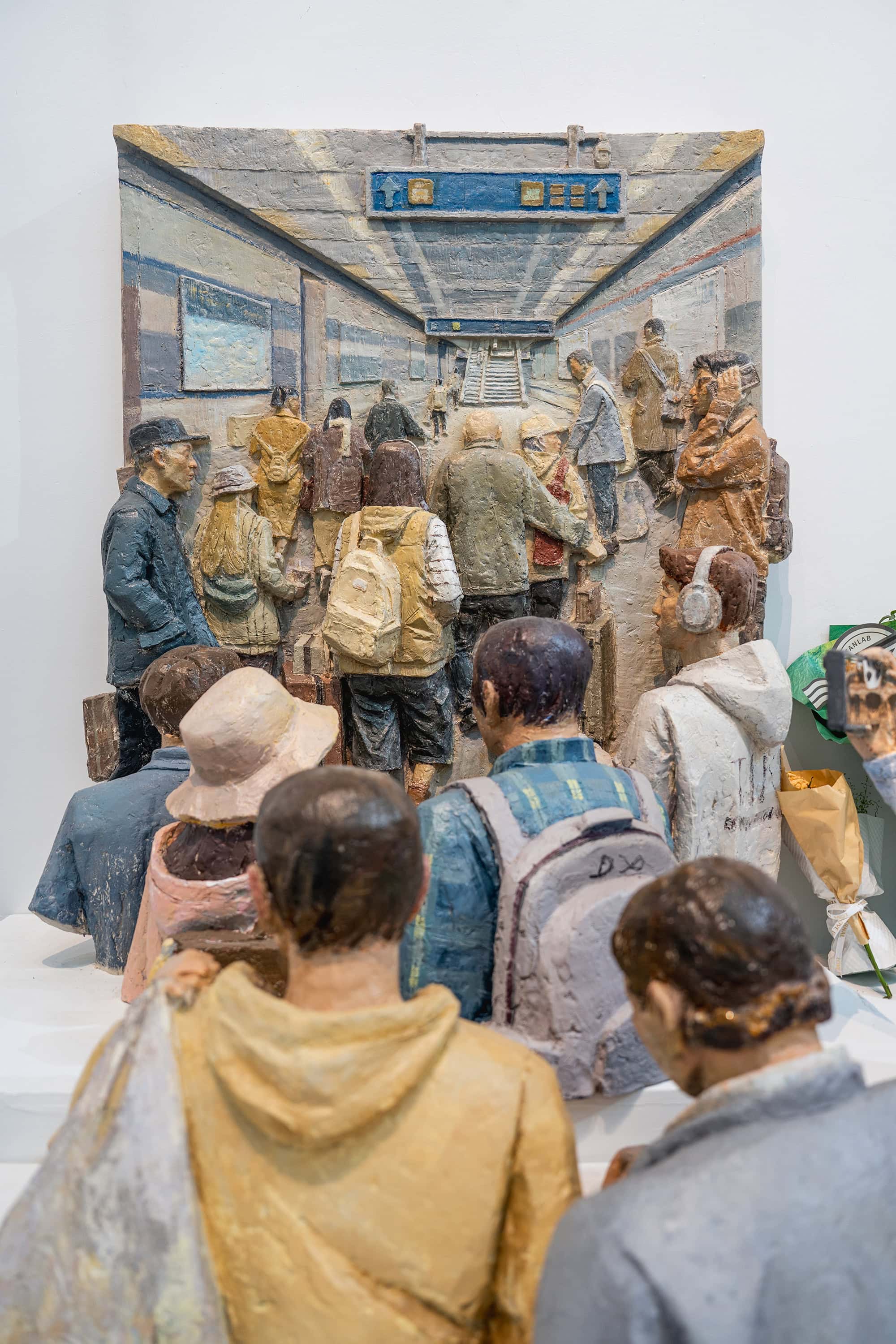
The second-to-last piece is about as realistic as it gets, and you can tell what it’s saying without any explanation. It depicts a bustling station scene rendered in the tradition of contemporary Chinese sculpture: a cross-section of humanity in motion, all driven by the same hunger. The crowd weaves like a current, each individual caught up in the tide of the times, shoulder to shoulder, leaning on one another, competing with one another. Order emerges through the push and pull, then dissolves again in the press of the crowd. The experiences and memories of each generation write the story of this shared rush toward some unnamed appointment.
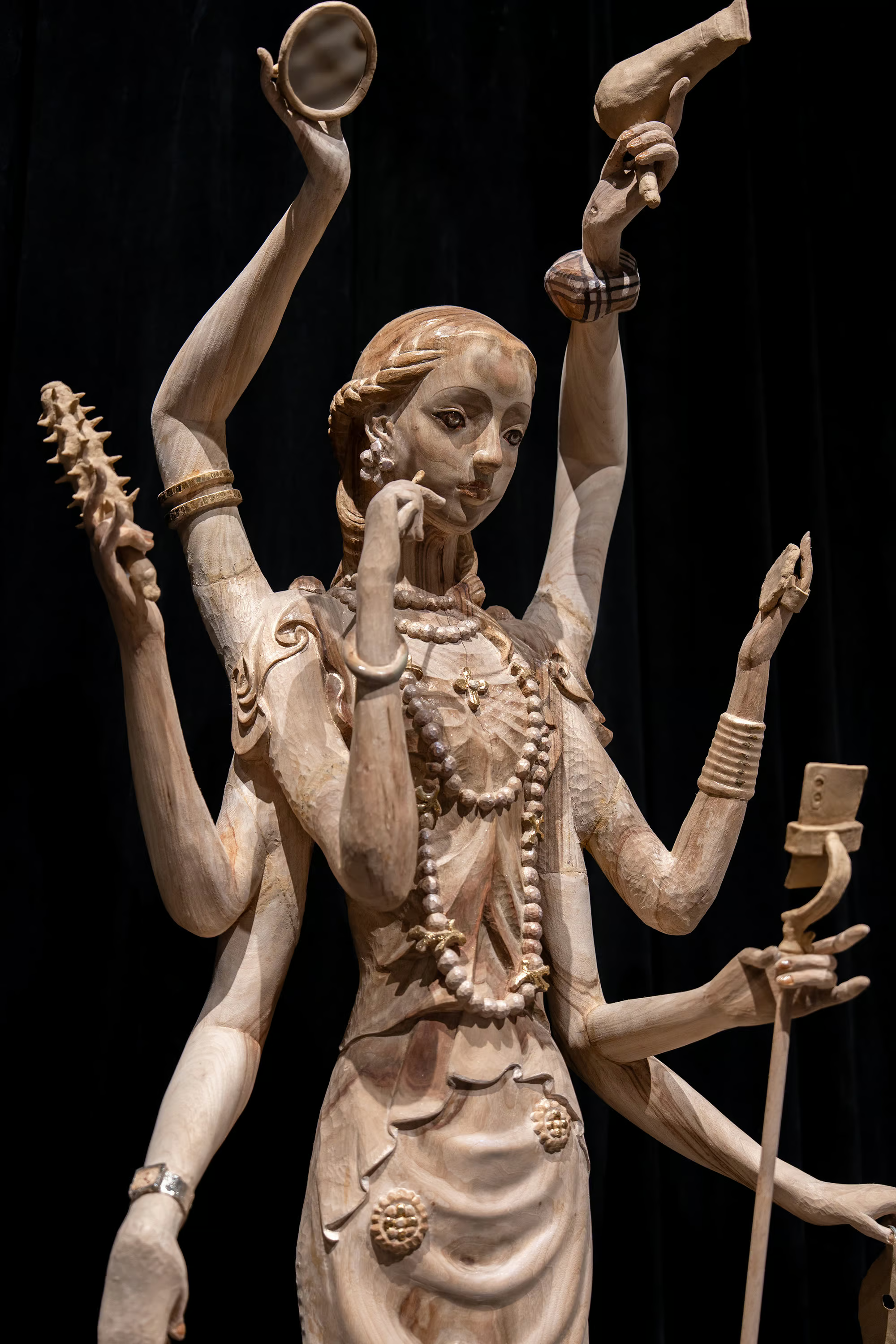
The last piece is also quietly pointed, and it’s worth noting that most of the work I photographed at this graduate exhibition was made by women, all of them remarkably attuned to the social currents of the present. These are feminist art pieces in the truest sense: not declarative, but observational. Lin Wanyi’s work Goddess captures the moment when an ordinary person becomes “divine”. On the road to becoming beautiful, cosmetics are the ritual instruments and the steps of a makeup routine are the disciplines of beauty: first the powder puff for base, then primer, then setting powder, then colored contacts and lashes. After this careful transformation, played out amid humidity, sweat, and loose powder, perhaps the ordinary person will earn beneath one of her social media posts a single comment: Goddess (a term of high praise in Chinese Internet culture, used to describe a woman who is exceptionally beautiful or put-together).
We use cookies to optimize your experience, analyze usage, and personalize content. Your continued browsing indicates consent to our cookie usage and the sharing of site interaction data with our marketing and analytics partners.