Travel & Planning for New Destination Released. Free Shipping to Most Countries Around the World.
Free Shipping to Most Countries Around the World.
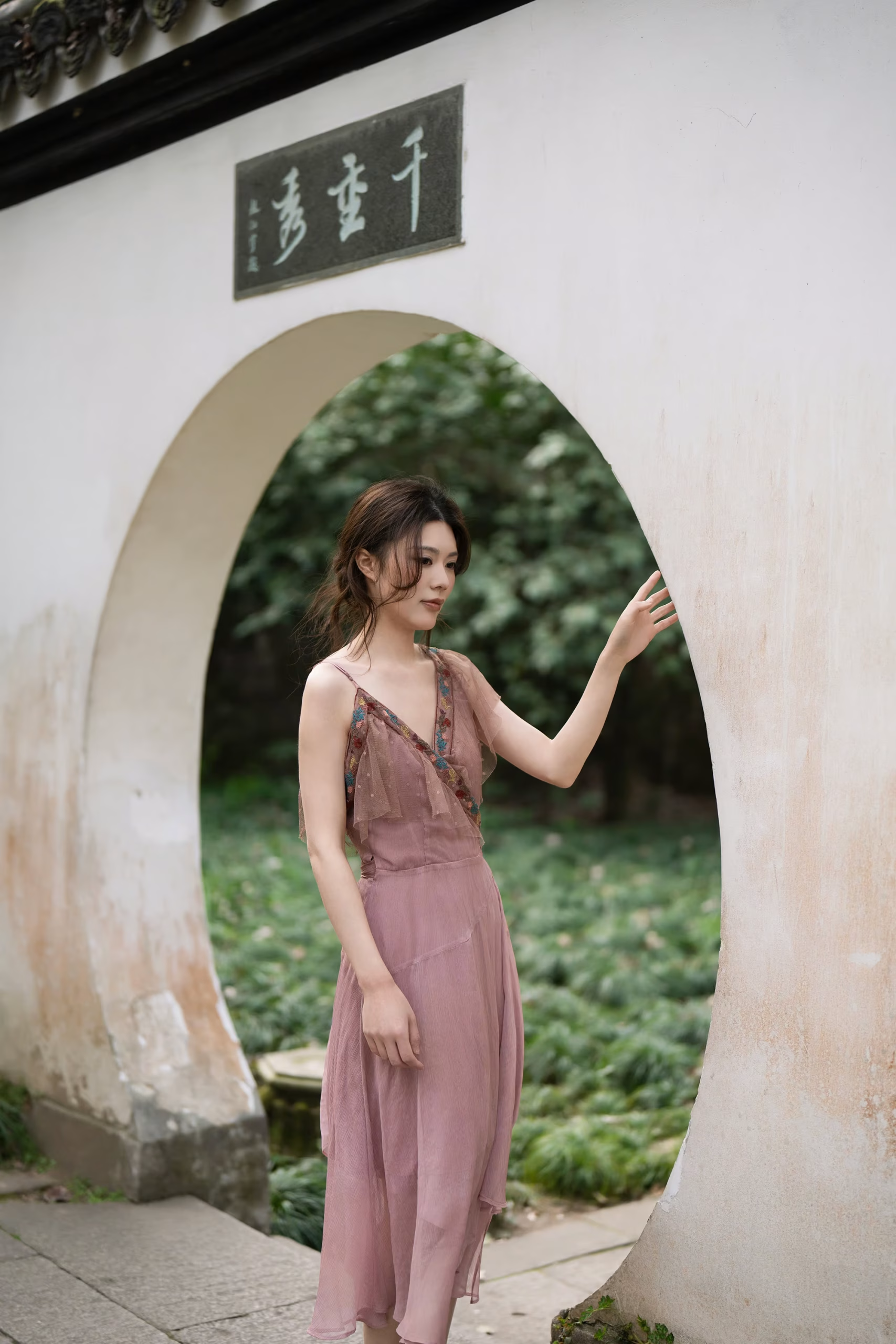
The moment you step through the gate, you walk into a tall forest of dawn redwoods. Sunlight filters through the leaves, creating shifting patches of light and shade that look beautiful in photos. The sound of the spring trickling over stones and the clear calls of birds instantly quiet the mind.
Follow the stone path and you will soon see a stone sculpture of a tiger. If you frame it from a distance, backed by the forested slopes, the scene has a very classical Chinese mountain atmosphere.
According to local legend, a monk once built his hut here but suffered greatly because there was no water in the mountains. One night he dreamed of a divine being who told him that two tigers would come to help. The next day, two tigers really did appear in front of his hut and began clawing at the ground. Before long, a clear spring burst forth. That is how the place came to be called Tiger Dream Spring.
When I was a child and came here to hike, I often saw elderly men carrying huge plastic water bottles, the kind you put on top of office water dispensers. They would fill them with spring water and carry them back down the mountain, one heavy jug after another. Tiger Spring water and Longjing tea are often spoken of together as the two local treasures, and they truly live up to the reputation.
Walk a little higher up the mountain and you reach Han Hui Pavilion, named for the way sunlight seems to wrap the pavilion in a soft halo. A bit further on, there are two symmetrical pools on the left and right. In earlier years, people used to release fish here; now the pools are mostly scattered with coins tossed in by visitors making wishes. The water is so clear that every stone at the bottom is sharply visible.
The architecture at Tiger Spring is also interesting. There is a courtyard and a bell tower, and the main hall was once part of a temple complex. Today some of the space has been turned into a teahouse. You can sit down, brew a pot of Longjing using Tiger Spring water, and simply stay still for a while. The teahouse is not open all the time though; on quiet days when there are hardly any visitors, it often stays closed.
Walk on and you arrive at the Ji Gong Stupa Courtyard. It is said that Ji Gong passed away here, and the stupa behind the courtyard holds his relics.
Another person closely connected with Tiger Spring is Master Hongyi, also known as Li Shutong. When he first came to Hangzhou, he taught at what is now Hangzhou High School, then called Zhejiang Provincial First Normal School, giving classes in art and music. Influenced later by ideas such as fasting for self‑cultivation in Japan, he chose to become a monk at Dinghui Temple in Tiger Spring, taking the dharma name Hongyi.
Many people tried to dissuade him at the time. Some knelt for hours, some traveled long distances, yet he remained firm in his decision to leave worldly life behind. He later passed away in Quanzhou, and some of his relics were brought all the way back to Tiger Spring, the place where he had first taken vows.
Tickets: 15 RMB. Entry is free if you hold a Hangzhou Park Card.
Getting there: It is very hard to hail a taxi here, especially on weekends, because the nearby zoo draws big crowds. Plan ahead and try to book your rides early for both arrival and departure. If you are not coming very early in the morning, it is better not to drive your own car. Parking spots are limited and fill up quickly.
We use cookies to optimize your experience, analyze usage, and personalize content. Your continued browsing indicates consent to our cookie usage and the sharing of site interaction data with our marketing and analytics partners.